
On a lovely summer’s evening in June 2026, the history group hosted a free event in which Bramcote’s church bells were the stars.
The evening began with a short presentation by Val Bird, Chair of the history group, about the original church and how the current church of St. Michael and All Angels was built in 1861.
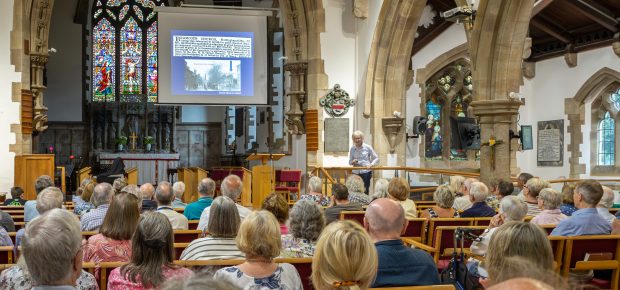
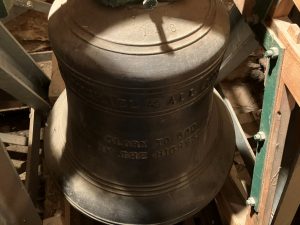
Christine Langton, Bramcote’s Bell Tower Captain, spoke about bell ringing techniques and the six bells that are rung regularly in St. Michael’s Church. Three of these bells have been in Bramcote’s churches for over 400 years!
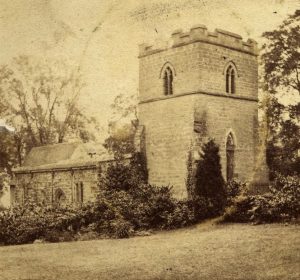
The old church tower that stands at the top of Town Street, facing Cow Lane and adjacent to Moss Drive, is believed to date from about 1246. To date, only one photograph of the entire church has been discovered. It was taken by Frederick Chatfield Smith, a keen early photographer, who lived at Bramcote Hall, which stood further up Moss Drive.
It is clear from this image plus written accounts that the small village church was in a state of disrepair by the middle of the nineteenth century. Seating just 30 people and measuring about 40 feet long and 14 feet wide, it could not serve the needs of the local population of around 700. The graveyard was full and the roof over the nave was something of a patched, temporary affair.
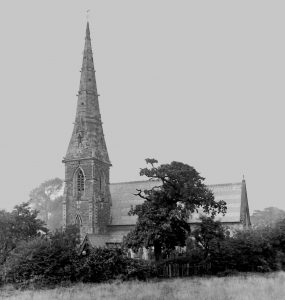
John Sherwin Gregory, the latter-day Lord of the Manor, came to the rescue and provided a plot of land (on what is now called Church Street) and some funding for the creation of a new church. The architect appointed was John Johnson, who was responsible for designing Alexandra Palace and the firm of John Firn of Leicester was given the building contract.
In March 1861, the foundation stone was laid by Mrs Catherine Sherwin Gregory, presumably when work was well under way as the service of consecration took place in December of the same year. A new vicar, the Reverend William Bury, took up residence in the vicarage on Moss Drive during that year too.
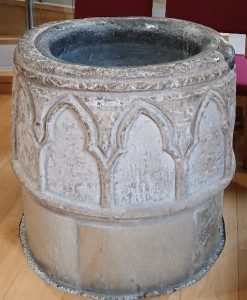
Our focus for the evening was on the items that were clearly cherished and carefully brought down from the old church to its successor. These consisted of a few memorial plaques, the Norman font and the three bells. What an effort it must have taken to relocate them all. A good deal of sheer physical labour would have been involved.
We can only imagine how delighted the villagers must have been when they came into this magnificent building for the very first time.
Over time, the church has gained further adornments…. some decorative, others of a more practical nature, and visitors on this evening were encouraged to take a thorough look around the building, have a go at bell ringing, view various displays in the church centre and enjoy some refreshments, with the choc ices proving most popular!